
ELECTION INTEGRITY AND IMPEACHMENT
TRUMP AND FDR

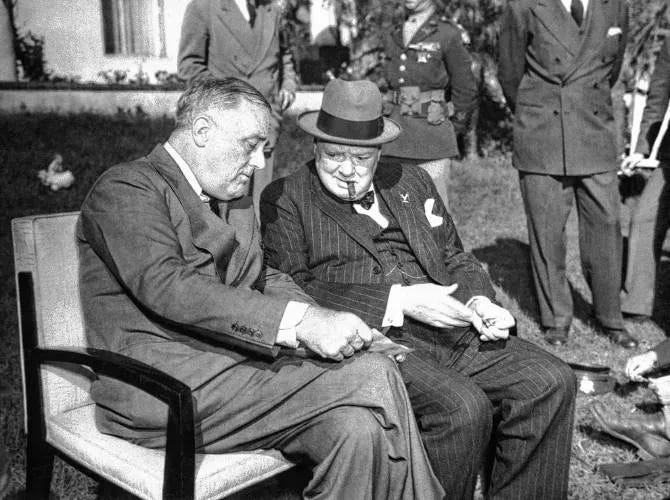
FDR and Winston Churchill (A.P.)
Governor Kelly Ayotte recently signed HB323 into law, which strengthened voting identification requirements. College IDs are no longer sufficient. This greatly concerns Democrats, who love out-of-state liberal college students tipping elections their way.
How do we know this?
College towns like Durham and Hanover regularly feature around 80% of voters choosing the blue team. Republicans naturally bristle about out-of-staters picking our elected officials. A great example is the 2016 U.S. Senate election where Ayotte lost to Maggie Hassan by 1000 votes. Ayotte had a narrow lead until the college vote from Keene was reported.
Many other N.H. elections have likewise gone blue. I once had a state rep race end in a tie. My vote total dropped by one vote in the recount. Later some of us later looked at the list of same-day registrants and mailed each of them at their reported address. Several came back as undeliverable. Does this mean they were illegitimate voters? We’ll never know. But somehow, I just know they didn’t vote for me!
President Trump claims the 2020 election was stolen from him and that procedures need to be tightened up. I disagree that the 2020 election was stolen, but I sympathize with the desire to tighten up voting procedures. Mailing in every ballot invites disenfranchisement and fraud. But states and localities establish voting protocols, as we did in N.H. with HB323. So, Trump should be careful about trying to impose federal voting policies on states, even if some states have dubious established policies with built-in blue advantages, such as on the west coast.
President Joe Biden (or his autopen) tried to do nationalize voting policies to benefit Dems with Executive Order 14019 in 2021. Republicans rightfully raised hell. Trump needs to be careful.
Trump was earlier accused of colluding with Russia to steal the 2016 election. An extended investigation found no evidence, but the charges created a fervor that helped lead to Trump’s first impeachment trial, in which he was acquitted. Thus, an innocent president was wrongly accused of election collusion.
That the Dems did what they did to Trump in 2019 was especially “rich” in that the Dems have a long, colorful, and documented history of unethical campaign practices. John F. Kennedy’s razor thin 1960 election is a case in point.
I wrote earlier about an especially egregious but unpublicized episode involving perhaps the most iconic Dem president. That historical chapter rates review, especially with Trump likely to be impeached by a Dem Congress next year.
FDR in 1940
In 1940 Franklin D. Roosevelt sought an unprecedented third term as President. But while his first two elections were landslides, the political landscape had changed. Americans were inherently troubled by the notion of an entitled presidency and a measure of “Roosevelt fatigue” set in.
Republicans sensed opportunity as three political heavyweights vied for the GOP nomination—Senators Robert A. Taft of Ohio and Arthur Vandenberg of Michigan along with District Attorney Thomas E. Dewey of New York.
Not only were most Americans uncomfortable with a third presidential term, but in 1940 they also opposed FDR’s internationalist leanings. Isolationism was the mood of the day, and the three Republican heavyweights reflected that prevailing sentiment.
But FDR rightly feared the growing Nazi menace and regularly communicated with British Prime Minister Winston Churchill. In fact, their correspondence began in September of 1939 when Churchill was still First Lord of the Admiralty.
Standing alone against Hitler, Churchill sought to pull America into world conflict—though he understood the constitutional and political constraints that FDR faced. But with his country battling for survival, Churchill desperately needed FDR to win reelection, as the three GOP contenders opposed the entangling arrangements with the British that Roosevelt favored.
So, Churchill’s people set up an intelligence operation based in New York to spy on Americans and influence our election—with FDR’s knowledge and tacit approval. The spy organization was headed by a Canadian, William Stephenson.
FDR loved secret machinations—while his people maintained a brilliant public relations machine. In that pre-television era, most Americans didn’t even know FDR was paralyzed and wheelchair-bound or that his health was rapidly deteriorating. But back channel contacts combined with America’s nascent but growing intelligence services allowed FDR to monitor Stephenson’s activities.
The British worked hard to support the late-entry, dark horse GOP candidacy of Indiana’s Wendell Willkie—who until 1939 was a Democrat and an earlier FDR supporter. Unlike the three Republican favorites, Willkie was an internationalist who supported Roosevelt’s tilt toward Britain.
The Brits reasoned that Willkie would be easier for FDR to defeat. But if Willkie did win, he’d similarly support Churchill. Willkie received only 10% of the votes on the first ballot at the brokered GOP Convention, but then Stephenson’s people released a phony poll indicating a groundswell of enthusiasm for Willkie, who then gained support on every subsequent vote, eventually winning the nomination after the sixth ballot.
During the ensuing campaign, Willkie supported FDR’s foreign policies, infuriating isolationists and fellow Republicans. Roosevelt easily won that third term.
So, did communication and coordination between Roosevelt’s people and British intelligence to rig that U.S. election constitute impeachable conduct? That 1940 collusion was infinitely worse than Trump’s clumsy phone call with a Ukrainian leader that was the basis for his first impeachment.
A consummate politician, FDR seldom left his fingerprints anywhere—unlike Trump, the consummate non-politician.
The Mueller Report indicated no Russian collusion on the part of Trump. Ergo, the need for something else to take him down—i.e. the Ukrainian phone call. Ironically, the real collusion involved the Clinton people and the bogus Steele dossier. And it was the Clinton Foundation that received huge amounts of Russian money, not the Trump campaign.
The realpolitik truth is that all countries care about other nations’ election outcomes and often seek to influence them—as Britain did in 1940. The U.S. has done so many times.
Trump is criticized for using informal back channels to conduct foreign policy. But back channels constitute de rigueur diplomacy. Indeed, FDR’s presidential advisor Harry Hopkins was his most trusted “ambassador” to Britain and elsewhere, although Hopkins never held that formal designation. In fact, it was back channel contacts (through journalist John Scali) in 1962 that helped JFK resolve the Cuban Missile Crisis. Likewise for Lyndon B. Johnson in 1968 in commencing Vietnam War peace talks.
For Democrats to set the impeachment bar so low as to use a phone call to overturn an election really does threaten our democracy and it set a horrifying precedent that may yet come back to haunt Dems. And shame on our all-Democratic N.H. congressional delegation for putting partisan interests ahead of our national well-being.
Yes, Americans often cringe at how President Trump speaks and does business. But next year, Democrats will somehow again succeed in making the bellicose billionaire the unlikely recipient of widespread sympathy with their inevitable over-the-top impeachment proceedings.
I don’t know from where FDR, JFK, or LBJ watch us today. But wherever they are, they must cringe at what their fellow Democrats are doing to our constitutional republic.
Radical Democrats are sowing a wind. They will reap a whirlwind.
#####